

Lupus nephritis (LN) is one of the most serious complications of systemic lupus erythematosus (SLE), and one of the easiest to miss early.
It starts when lupus-driven immune complexes deposit in the glomeruli, the kidney's microscopic filters, and begin triggering inflammation.
When left unchecked, that inflammation causes permanent loss of functioning kidney tissue, chronic kidney disease, and eventually kidney failure.
A significant proportion of SLE patients develop LN, often within the first several years of disease.
What makes LN dangerous is how quietly it can progress. The kidneys can sustain real inflammation without showing dramatic symptoms: no edema, no visible change in the urine, and a serum creatinine that stays relatively normal even as damage accumulates.
Often the only early warning is what turns up on urine testing: proteinuria, microscopic hematuria, an active sediment.
The patient who taught me about delay
She was 21. A young African American woman with unexplained fatigue, migratory joint pain, and a rash no one could decipher.
By the time I diagnosed her with lupus, her disease had likely been active for months. It soon became clear it was affecting her kidneys as well.
She needed a biopsy to confirm lupus nephritis.
But, getting a biopsy became an uphill battle.
Nephrology referral took weeks. Once the nephrologist agreed to the biopsy, coordinating with interventional radiology added more time: scheduling, insurance authorization, pre-procedure clearance.
Each step's delay stacked on the last, and months passed before my patient finally had a renal biopsy.
By then, the tissue showed active inflammatory disease on top of chronic damage.
We could treat the active part. But we couldn't reverse the chronic damage that had already happened.
That case taught me a lesson I still think about with every lupus patient I see: in lupus nephritis, delayed diagnosis can mean irreversible kidney damage.
What PCPs should take away:
1. Don't wait for creatinine to rise.
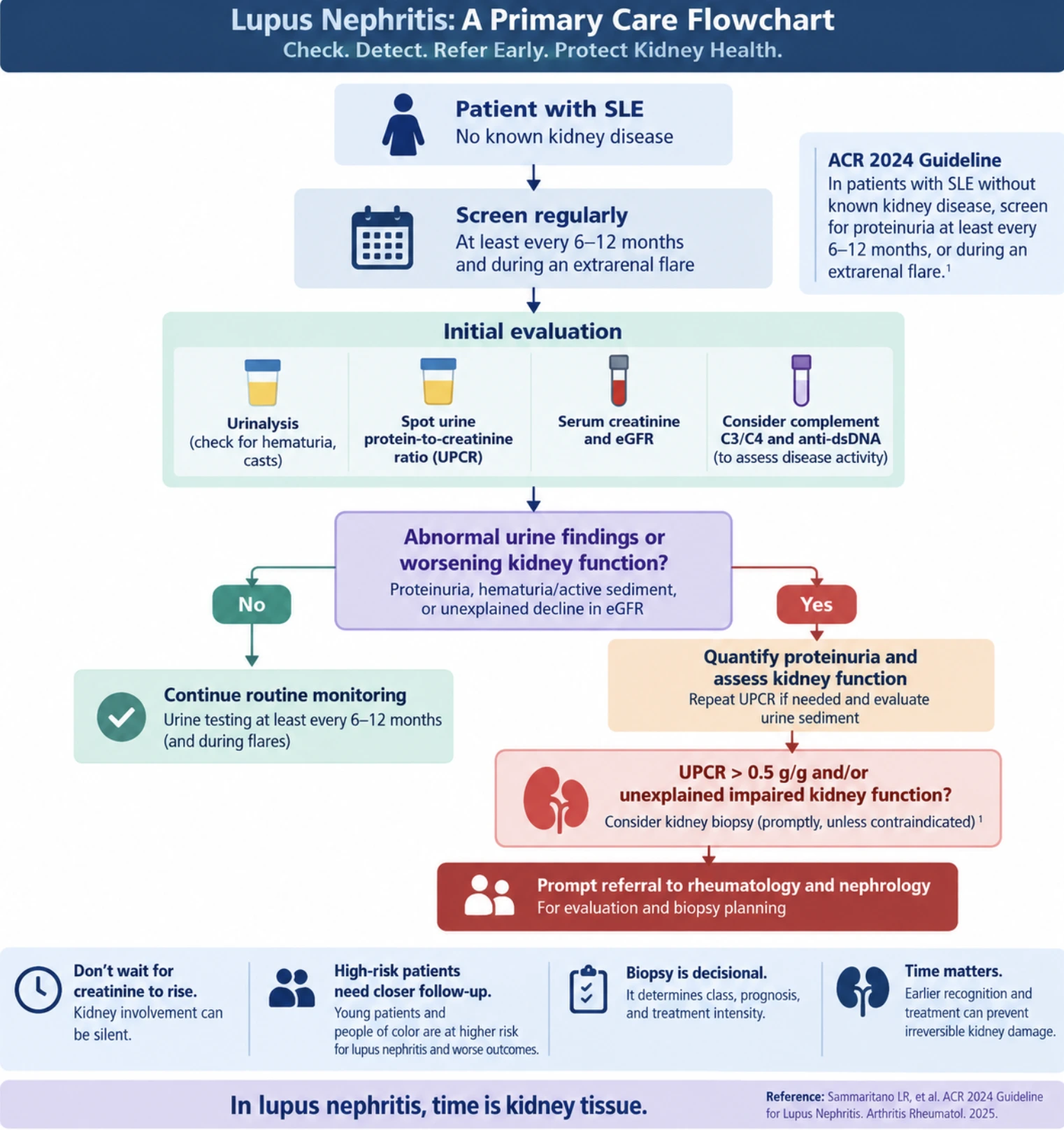
Kidney surveillance in SLE shouldn't depend on symptoms or serum creatinine alone. The ACR recommends screening SLE patients without known kidney disease for proteinuria at least every 6–12 months, and during any extrarenal flare. A practical kidney check:
- Urinalysis — hematuria, active sediment
- Spot urine protein-to-creatinine ratio (UPCR) — quantifies proteinuria
- Serum creatinine/eGFR — kidney function
- C3/C4 and anti-dsDNA — lupus activity in context
2. Know when the biopsy conversation should start.
A kidney biopsy in LN isn't just confirmatory, it's decisional. Two patients with similar labs can have very different pathology, and biopsy is what distinguishes treatable inflammation from irreversible chronicity. The ACR conditionally recommends biopsy for SLE patients with UPCR >0.5 g/g and/or otherwise unexplained impaired kidney function.
As a PCP, you don't need to decide who gets biopsied. You simply need to recognize who needs rheumatology and nephrology involved promptly.
3. Pay attention to the urine.
New or rising proteinuria, glomerular hematuria, cellular casts, or an unexplained dip in kidney function shouldn't just be watched until the next routine visit. And remember: a normal creatinine does not rule out clinically important lupus nephritis.
The opportunity for a PCP is usually upstream of the biopsy — catching the signal early enough that the patient reaches specialists.
Check the urine. Quantify the protein. Recognize the signal. Refer early.
Because in lupus nephritis, the treatment window that matters most may close before the creatinine ever rises.
References
1. Sammaritano LR, Askanase A, Bermas BL, et al. 2024 American College of Rheumatology Guideline for the Screening, Treatment, and Management of Lupus Nephritis. Arthritis Rheumatol. Published 2025.
2. Anders HJ, Saxena R, Zhao MH, et al. Lupus nephritis. Nat Rev Dis Primers. 2020;6:7. doi:10.1038/s41572-019-0141-9.
3. Rovin BH, Parikh SV. The kidney biopsy in lupus nephritis: is it still relevant? Rheum Dis Clin North Am. 2014;40(3):537–552.
4. Almaani S, Meara A, Rovin BH. Update on Lupus Nephritis. Clin J Am Soc Nephrol. 2017;12(5):825–835. doi:10.2215/CJN.05780616.