

Back pain is one of the most common complaints in primary care.
Most cases are mechanical: the majority of patients will never need to see a rheumatologist.
But in a smaller subset, back pain is the first sign of inflammatory spinal disease.
Axial spondyloarthritis (axSpA) is an inflammatory arthritis affecting the spine that often begins in young adulthood.
Early disease may not show up on a routine X-ray, which makes it easy to miss.
This article covers five clues that back pain may actually be axSpA, and when it's time to refer to rheumatology.
1. The Back Pain Sounds Inflammatory
Start with the history.
Inflammatory back pain typically begins before age 45, develops gradually, improves with activity and nonsteroidal anti-inflammatory drugs (NSAIDs), and worsens with prolonged rest.
Patients may describe significant morning stiffness, often feeling like a “tin man” or a “tin woman”, or pain that wakes them during the second half of the night.
Compare these symptoms with mechanical back pain, which is the opposite: it worsens with activity and improves with rest.
No single symptom helps diagnose axSpA. But when several of these features occur together, especially in a younger patient under the age of 45, your suspicion for axSpA should rise.
2. There Are Clues Outside the Back
Sometimes the biggest clue to inflammatory back pain isn't just in the spine.
Patients can have extra-articular manifestations, i.e., symptoms outside the joints.
Ask patients about psoriasis, bloody diarrhea (inflammatory bowel disease), and episodes of a painful, red, light-sensitive eye (anterior uveitis).
Also assess for other sites of musculoskeletal pain, particularly at the Achilles tendon or plantar fascia (enthesitis).
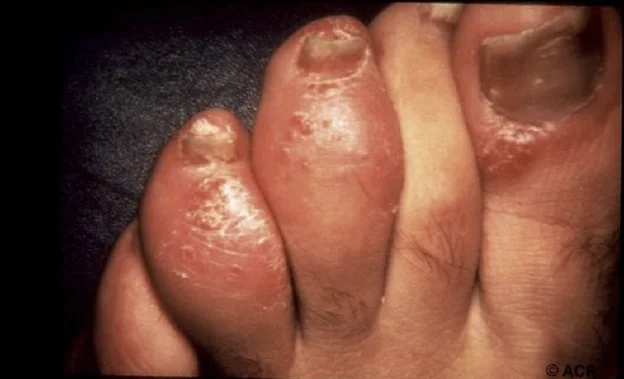
Patients may describe a "sausage digit": swelling of an entire finger or toe. This is known as dactylitis, and strongly supports a diagnosis of spondyloarthritis.
Family history matters, too. A first-degree relative with spondyloarthritis should lower your threshold for referral to rheumatology.
3. The X-ray Shows Sacroiliitis
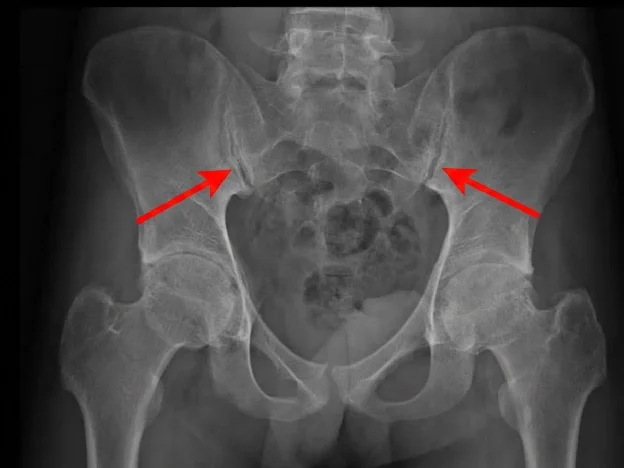
When evaluating suspected axSpA, pay attention to the sacroiliac joints, not just the lumbar spine.
On X-ray, sacroiliitis may show up as erosions, subchondral sclerosis, joint space narrowing, and eventually ankylosis.
4. The X-Ray Is Normal, but the Patient Is Not Improving
This is one of the most common reasons axSpA gets missed.
A normal x-ray does not exclude axial spondyloarthritis.
Patients can have symptoms and active inflammation before structural sacroiliac joint changes become apparent on x-rays.
This is called non-radiographic axial spondyloarthritis.
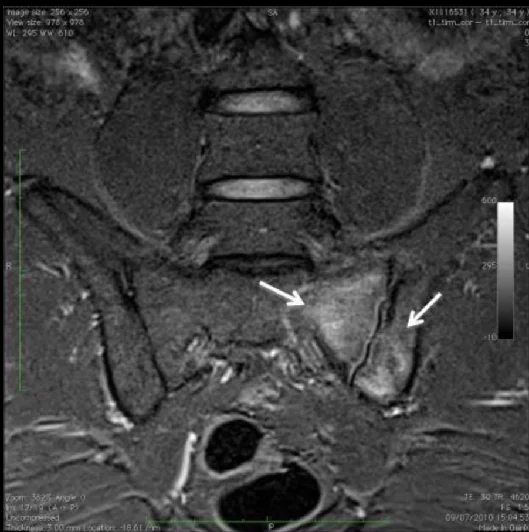
So, if the x-rays of the sacroiliac joints appear normal, but the patient is still reporting back pain with morning stiffness, proceed to MRI.
MRI of the sacroiliac joints can identify early inflammatory changes, such as bone-marrow edema, long before x-ray picks up structural damage.
5. The Labs Support the Story
HLA-B27 can be helpful, but only when interpreted in context.
A positive HLA-B27 does not diagnose axSpA, and a negative test does not exclude it.
Similarly, ESR and CRP may support evidence of inflammation, but normal inflammatory markers do not rule out disease.
Avoid using HLA-B27, or a broad “rheumatology testing panel”, as general screening for back pain.
Testing is most useful when the patient's clinical picture has already raised suspicion.
The Takeaway
Most back pain isn't inflammatory. The challenge is recognizing the smaller group of patients who warrant a closer look.
Think about axSpA when chronic back pain begins before age 45, especially when it is accompanied by these features: improvement with movement, prolonged morning stiffness, psoriasis, uveitis, inflammatory bowel disease, enthesitis, dactylitis, a relevant family history, or sacroiliitis on imaging.
And don't let a normal x-ray, or normal inflammatory markers, end the evaluation when the clinical picture remains suspicious.
You don't need to test every patient with back pain. You need to recognize the patient who may need rheumatology.
References
- https://enthesis.info/spondyloarthritis/dactylitis_and_enthesitis.html
- https://www.orthobullets.com/spine/2044/ankylosing-spondylitis
- https://www.researchgate.net/figure/STIR-sequence-MRI-of-the-sacroiliac-joints-SIJs-in-a-38-yr-old-male-with-a-4-month_fig2_236968721
- https://www.nice.org.uk/guidance/NG65/chapter/Recommendations
- https://pmc.ncbi.nlm.nih.gov/articles/PMC11671888/